


LED Knowledge
Frequently Asked Questions.
CLEAR, EXPERT ANSWERS.
Practical knowledge about LED technology, railway applications, retrofit, obsolescence and project implementation.
01Why are T5 and T8 fluorescent tubes disappearing?
The EU Ecodesign Regulation (EU) 2019/2020 and stricter RoHS requirements ended the placing on the market of conventional T5 and T8 fluorescent tubes in August and September 2023. Remaining stocks may still be sold. Operators should therefore plan suitable LED alternatives or retrofit solutions in good time.
02Why are many ballasts also being discontinued?
As conventional fluorescent lighting declines, demand for magnetic, conventional and electronic ballasts also falls. Manufacturers are reducing or ending production. In long-life installations, the ballast can therefore become an obsolescence issue as well as the light source.
03Retrofit or complete replacement—which is more appropriate?
This depends on the condition, installation situation, control gear, applicable standards and economic factors. If the existing luminaire is mechanically sound, a suitable retrofit can avoid considerable installation, material and downtime costs. A complete replacement is more appropriate for damaged or technically unsuitable luminaires.
04What does obsolescence management mean?
Obsolescence management addresses components, products or spare parts that are no longer available. Its purpose is to develop alternatives, reproductions or retrofit solutions at an early stage. Our objective is not to replace functioning installations, but to keep proven systems operating economically and reliably with minimal modification.
05Why are thermal management and material selection particularly important for railway LED tubes?
LED technology is sensitive to sustained thermal stress. In SUPERIS RAIL, glass and aluminium are combined so that fire safety and thermal behaviour are considered together. A higher number of deliberately under-driven LEDs produces less heat per LED. Aluminium end sections support heat dissipation where required. Although using more LEDs increases material cost, it improves thermal management and service life.
06What does DIN EN 45545-2 cover?
DIN EN 45545-2 addresses the fire behaviour of materials and components used in rolling stock. A luminaire or LED tube is assessed as a complete product, including its materials, masses and operating conditions—not merely as an individual material.
07Why is EMC important outside the railway sector as well?
Electromagnetic compatibility means that a device does not cause unacceptable interference to other equipment and is itself sufficiently immune to interference. This applies to all electronic products requiring CE marking. Interference may appear as poor radio reception, unresponsive remote controls, disrupted radios, control systems or emergency call systems. Railway applications are subject to particularly stringent requirements.
08Why does SUPERIS RAIL have a 320° light distribution?
Conventional fluorescent tubes emit light almost all around and use reflectors and luminaire housings for light distribution. The patented 320° light distribution of SUPERIS RAIL closely reproduces this behaviour, allowing the existing luminaire to remain in use without fundamentally changing the original lighting effect.
09Why does LED modernisation make economic sense?
Economic value is not determined by lower power consumption alone. Maintenance intervals, replacement costs, accessibility, downtime and the ability to reuse existing housings, trunking rails or wiring are also decisive. The complete lifecycle should therefore always be considered.
10Which colour temperature is suitable for which application?
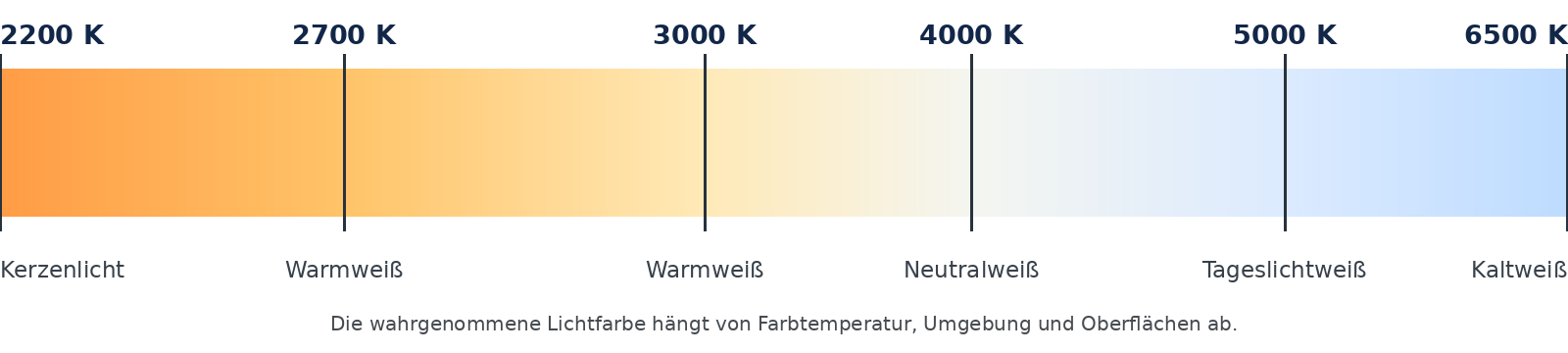
The appropriate colour temperature depends on the use, spatial effect and visual task. Warm white creates a comfortable atmosphere, neutral white suits many office, retail and working areas, and daylight white supports technically oriented workplaces. Colour rendering, illuminance and surface colours are also important.
11What service life can LED tubes and LED luminaires achieve?
Service life depends on thermal management, ambient temperature, components, driver design and operating conditions. Typical values from the Schmelter portfolio are approximately 70,000 hours for SUPERIS SI4, up to approximately 90,000 hours for technically simplified single-ended SUPERIS versions, approximately 60,000 hours for SUPERIS RAIL under the specific stresses of railway operation, and more than 100,000 hours for suitable SOLIS large-area and street luminaires.
12Why is the LED driver so important?
The driver supplies the LEDs with the required current and influences service life, light quality, efficiency, EMC, surge behaviour and operational safety. Complexity increases with additional functions. A sound design therefore integrates exactly the functions required for the specific application.
13What does obsolescence mean in machine and plant engineering?
Obsolescence means that products, components or spare parts can no longer be manufactured or procured. Often, only one component—not the complete machine or installation—is obsolete. Reproduction or technical adaptation can frequently preserve functionality over the long term.
14When is reproduction more economical than a new development?
Reproduction can be appropriate when individual components such as special glass panels, diffusers, control panels, mechanical parts or electronic assemblies are missing. If shape, dimensions and technical properties correspond to the original, extensive new approvals may be avoided depending on the project. Technical requirements and possible intellectual property rights must be checked first. We cannot reproduce everything—but considerably more than many operators expect.
15Why is retrofit more sustainable than complete replacement?
In a retrofit, housings, mountings, trunking rails, wiring and other functioning components remain in use. This reduces material consumption, waste, transport and installation effort. Sustainability does not automatically mean purchasing everything new.
16What are the advantages of reusing existing luminaires?
Existing installation dimensions, mountings, light distributions and wiring can be retained. This reduces investment and installation costs and may also limit documentation and testing effort depending on the project. Proven systems remain in place while the lighting technology is modernised.
17How does a retrofit or obsolescence project proceed?
First, the existing situation, dimensions, photos, rating plates and technical requirements are recorded. We then assess standard products, adaptations, reproduction or custom development. One example is Emser Therme, where an existing LED luminaire was adapted to the existing ceiling cut-outs and required installation depth using magnets and adjustable threaded rods.
18Does Schmelter also develop customised solutions?
Yes. These include custom lengths, custom voltages, customer-specific circuit boards, special light distributions, retrofit kits, reproductions, individual items and small series. Technical feasibility, requirements and economic benefit are decisive.
19What information is required for an enquiry?
Helpful information includes photos, dimensions, rating plate, article number, operating voltage, application location, quantity, technical requirements and available drawings or data sheets. If information is missing, we assist with identification. A clear photograph is often enough for an initial assessment.
20From what quantity does a custom development become economical?
There is no fixed minimum quantity. Development effort, tooling costs, technical complexity and the benefit to the operator are decisive. Even a prototype or small series can be economical if it keeps an expensive installation in operation or avoids complete replacement.
Another Question?
Request a Technical Application Review
Photos, dimensions or existing documentation are often sufficient for an initial assessment.